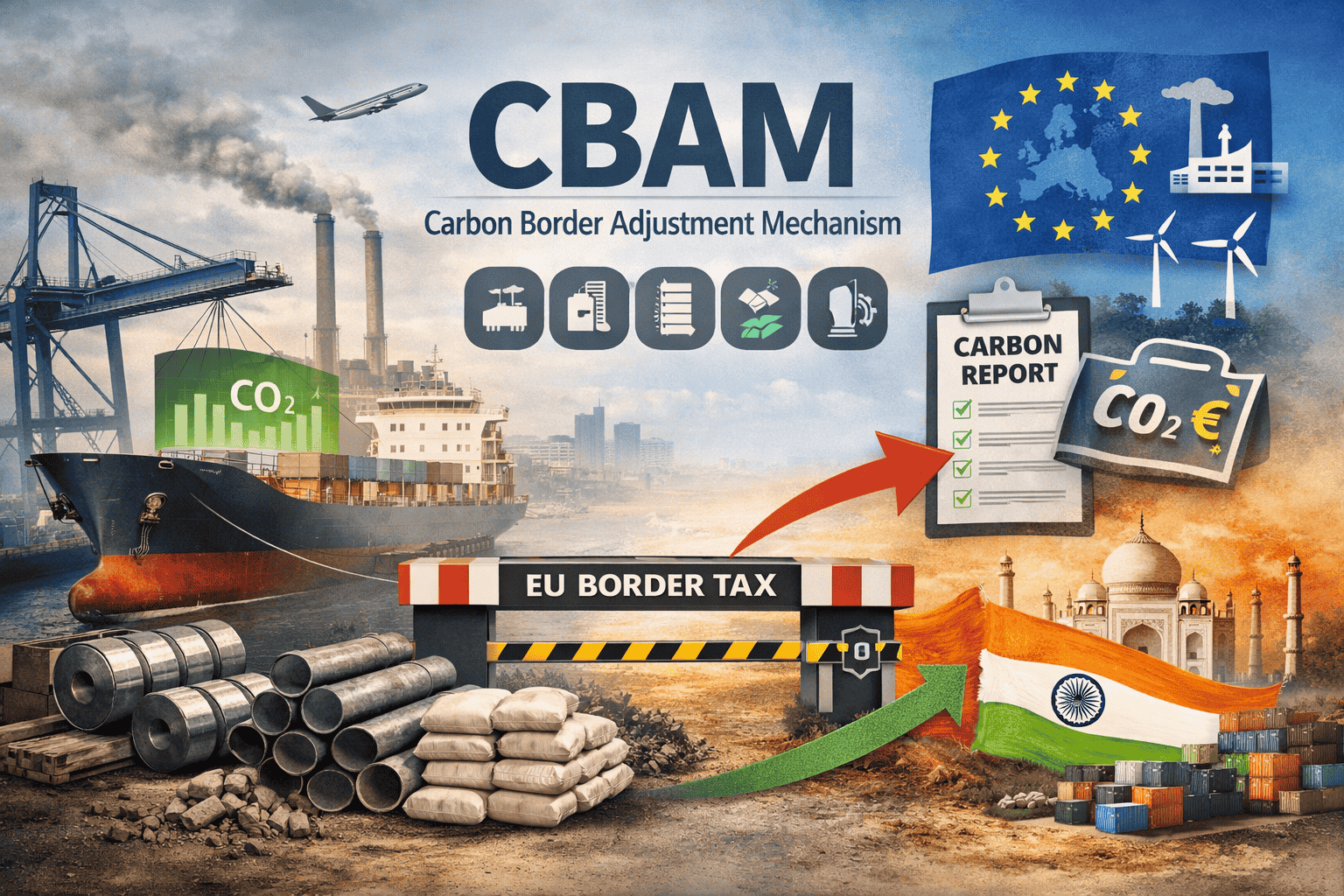
When Global Trade Meets the Cost of Carbon
A massive freighter leaves Shanghai and docks in Rotterdam, unloading low-cost steel into the European market.
For decades, this was global trade working exactly as theory promised.
Countries specialised in what they did best.
Producers lowered costs.
Buyers benefited.
Markets stayed efficient.
Comparative advantage at work.
But there was a cost that never appeared on the invoice.
Behind this efficiency lay unpriced carbon emissions; pollution released during production, transport, and energy use. While European manufacturers were required to pay for these emissions under the EU’s Emissions Trading System (ETS), imports produced without similar carbon constraints continued to enter the market at lower prices.
European factories paid to decarbonise.
Imports stayed cheap.
Competitiveness suffered.
This imbalance is what the EU set out to correct.
What Is CBAM?
The Carbon Border Adjustment Mechanism (CBAM) is the European Union’s policy response to carbon leakage, the shifting of production to countries with weaker or no carbon pricing rules.
Effective January 2026, CBAM places a carbon cost on certain imported goods, ensuring they face a similar emissions price as products manufactured within the EU.
CBAM is not just a climate policy.
It is a trade regulation with direct financial implications for exporters to Europe, including Indian manufacturers.
Why CBAM Matters for Indian Businesses
By 2023, European manufacturers were already paying significant costs under the EU Emissions Trading System (ETS), which caps emissions and requires companies to buy allowances for every tonne of carbon they emit.
At the same time, imports from countries such as India, China, and Turkey, where no equivalent carbon pricing existed, continued to enter EU markets at lower prices.
The result:
- Higher costs for EU producers
- No reduction in global emissions
- Production shifting abroad instead of becoming cleaner
For Indian exporters, this means carbon data is now a trade requirement, not a sustainability add-on.
Which Products Are Covered Under CBAM?
CBAM currently applies to six carbon-intensive product categories:
- Cement
- Steel
- Aluminium
- Fertilisisers
- Electricity
- Hydrogen
If your company exports any of these, directly or as part of a larger supply chain, CBAM compliance will impact you, even if the legal obligation sits with your EU importer.
CBAM Timeline: Where Are We Today?
CBAM has now entered its definitive phase, marking a shift from learning to enforcement.
What This Means in Practice
- Reporting has moved from quarterly to annual
- Importers must now purchase CBAM certificates based on reported emissions
- Strict verification and compliance checks apply
For exporters, this means data readiness today determines market access tomorrow.
CBAM Compliance Requirements: What Needs to Be Reported?
1. CBAM Registration
EU importers bringing in more than 50 tonnes of CBAM-covered goods must register as CBAM Declarants through the CBAM portal.
They are required to:
- Declare embedded emissions annually
- Purchase CBAM certificates from national authorities
- Surrender certificates equivalent to reported emissions
2. CBAM Reporting: Key Information Required
Each CBAM report must include:
Product Information
- Type and quantity of goods (EU CN codes)
- Country of origin
- Producer and installation identification
- Direct emissions from production processes
- Indirect emissions, such as electricity consumption
- Calculated strictly under EU CBAM methodologies
- Any carbon tax or price already paid in the country of origin
- Eligible deductions that may reduce overall CBAM liability
CBAM Is Not Just a Compliance Exercise
For Indian businesses, CBAM signals a larger shift:
- Buyers will demand verified emissions data
- Carbon transparency will influence supplier selection
- Poor data quality may result in higher costs or lost contracts
- Strengthen relationships with EU buyers
- Protect margins
- Position themselves as future-ready suppliers
At KathaVista, we help organisations navigate CBAM with clarity, structure, and confidence.
Our CBAM support ensures your reports:
1. Tell a Clear, Compliant Story
We translate complex emissions data into structured, regulator-ready narratives that meet EU expectations.
2. Align Fully with EU CBAM Frameworks
Our reports follow EU-prescribed CBAM formats, methodologies, and evolving guidance.
3. Are Data-Driven and Verification-Ready
We help build documentation that stands up to audits, reviews, and scrutiny, not just initial submission.
CBAM preparation is no longer optional.
It is now a strategic business requirement.
Prepare Early. Compete Smarter.
If your supply chain includes CBAM-covered goods, the time to act is now.
Write to us at: solutions@kathavista.com
Let’s ensure your CBAM reporting is compliant, credible, and future-ready.